

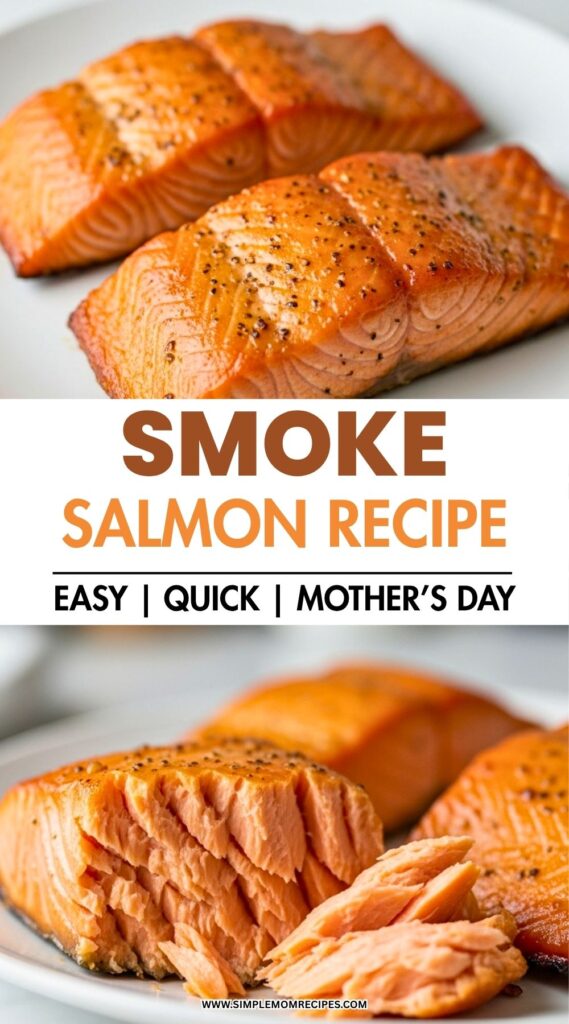
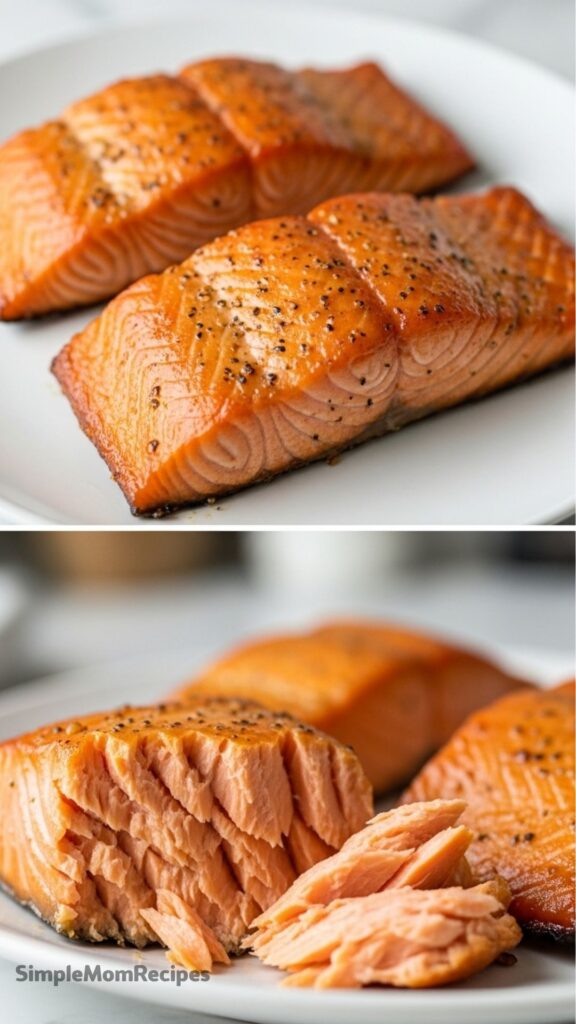
Smoky, slightly sweet salmon with a glossy surface and tender flakes – the kind that disappears faster than you expect.
I keep opening the smoker lid too early. I know I shouldn’t. Heat drops, smoke escapes, and I just stand there pretending I’m “checking progress” when really I’m impatient. Today I told myself I’d wait. I didn’t. Fifteen minutes in, I peeked. The fish looked pale and kind of wet and I immediately regretted rushing it.
Smoking salmon is slow in a way that tests you. Not hard, just… stubborn. You can’t bully it. You can only guide it.
Ingredients I Used for the Recipe
- 2 to 3 pounds salmon fillets – skin on, helps hold everything together
- 1 quart cool water – base for the brine
- 1/3 cup kosher salt – pulls moisture and seasons deep
- 1 cup brown sugar – balances salt, gives that slight caramel note
- 2 to 3 tablespoons maple syrup – brushed on for sweetness and shine
- 1 teaspoon black pepper – optional, adds a little bite
- Wood chips or pellets (alder or apple) – mild smoke works best here
- 1 tablespoon oil – keeps fish from sticking to the rack
Something that almost ruined the dish
I almost skipped drying the fish after brining. It felt like an unnecessary wait. Big mistake. I tried that once before and the smoke barely stuck. The surface stayed dull, no shine, no depth. This time I forced myself to do it properly, even though it meant pacing around the kitchen doing nothing productive.
That slightly tacky surface that forms – it doesn’t look like much, but it changes everything.
How to make How to Smoke Salmon?
Step 1 – Mix the brine
I stirred the salt and brown sugar into cool water until it mostly dissolved. Not perfectly. Some grains always sit at the bottom and I stop caring after a point. Tossed in a bit of black pepper because I like that subtle kick later.
Step 2 – Submerge the fish
Laid the salmon pieces into a shallow container and poured the brine over. I had to flip one piece because it kept floating like it didn’t want to cooperate. Covered it and shoved it into the fridge.
I left mine for about 8 hours. Thinner pieces need less, thicker ones more. Once I forgot and left it too long. The salt hit too hard. Not terrible, but not great either.
Step 3 – Rinse and dry
Took the salmon out, gave it a quick rinse under cold water. Not a soak, just enough to wash off surface salt. Then I patted it dry with paper towels.
Set the pieces on a rack. This is where patience kicks in. I let them sit for about 3 hours. A fan helps. Even a slightly open window works. The surface turns a little shiny and sticky. That’s what you want.
Step 4 – Prep the smoker
I went with alder wood this time. It smells clean, not too aggressive. Heated the smoker slowly. I started low, around 140°F. I’ve rushed this before and ended up with that weird white stuff leaking out of the fish. Not ideal.
Step 5 – Oil and place the fish
Brushed a bit of oil on the skin so it wouldn’t stick. Learned that the hard way after peeling half a fillet off a rack once.
Placed the fish skin side down and closed the lid. This is where I try not to hover. Try.
Step 6 – Start smoking gently
Kept the temperature low for the first hour. The fish slowly firms up. The smell starts faint, then builds. Not strong, just present. Like something good is on the way.
Step 7 – Baste and raise the heat
After about an hour, I brushed maple syrup over the top. It felt a bit messy, and I dripped some onto the rack. Happens every time.
Increased the heat slightly to around 165-175°F. Not blasting, just easing it up.
Step 8 – Keep smoking and basting
Every hour, another light brush of syrup. It adds layers. Also helps hide any of that white albumin if it shows up. A little is fine. A lot means the heat got too high. I’ve been there.
Step 9 – Check doneness
After about 2 to 3 hours total, I checked the texture. The fish should flake easily but still look moist inside. Not dry, not chalky.
I don’t always use a thermometer, but when I do, I aim for around 135°F inside.
Step 10 – Rest before storing
Took the salmon off and let it sit on the rack for about an hour. It smells incredible at this point. Hard not to pick at it. I usually break off a corner piece. Quality control.
Texture, smell, and the little things
The outside gets slightly glossy from the syrup. Not sticky, just smooth. Inside stays soft and flaky. If you press gently, it gives but doesn’t fall apart instantly.
The smell is the best part. It clings to your clothes a little. Not in a bad way. More like a reminder you did something right.
Sometimes the edges get a bit darker than the center. I actually like that. Slight chew, deeper flavor. I always go for those pieces first.
A small habit I follow every time
I cut the salmon into smaller portions before brining. Not neat, perfect cuts. Just manageable sizes. They cook more evenly and I don’t have to wrestle with a giant fillet later.
Also, I never skip lining the bottom of the smoker tray with a bit of water. Keeps the heat steady. One time I didn’t and the temperature spiked faster than I could fix it. The fish survived, but barely.
Tips
- Don’t rush the drying step – that surface layer makes a huge difference
- Keep the heat low at the start – high heat pushes out moisture
- Use mild wood – strong smoke can overpower the fish quickly
- Brush syrup lightly – too much turns messy and overly sweet
- If white protein shows up, don’t panic – just wipe or brush it off
- Let the fish rest before storing – it settles and firms up better
- Store in the fridge up to a week, or freeze if you made too much
I don’t think I’ve ever made smoked salmon the exact same way twice. Something always shifts. Timing, wood choice, even how patient I feel that day. But the core stays the same – slow heat, a bit of sweetness, and not messing with it too much.
And yeah, I still open the lid earlier than I should. Some habits stick.
Smoke Salmon Recipe
Description
This hot-smoked salmon recipe delivers tender, flaky fish with a rich smoky flavor. Unlike cold-smoked lox, this method cooks the fish gently, resulting in a golden, delicious meal perfect for salads, pasta, or eating plain. The key is a proper brine and forming a pellicle before smoking at low temperatures.
Ingredients
The Fish
The Brine
For Basting
Instructions
Prepare the Brine
Mix the cool water, kosher salt, and brown sugar in a large non-reactive container (plastic or glass) until dissolved.Cure the Salmon
Submerge the salmon fillets completely in the brine. Cover and refrigerate. Cure thin fillets (trout/pink salmon) for at least 4 hours. Medium fillets (sockeye/coho) need about 8 hours. Thick king salmon may require up to 36 hours. Do not exceed 48 hours or the fish will be too salty.Double brine ingredients if necessary to cover all fish.Form the Pellicle
Remove fish from brine, rinse briefly under cold water, and pat dry. Place fillets skin-side down on a wire rack. Allow them to air dry in a cool (60°F/15°C or cooler), breezy place or under a fan for 2-4 hours. The surface should become shiny and tacky; this is the pellicle, which helps smoke adhere and seals in moisture.This step is critical for texture and smoke absorption.Preheat Smoker
Oil the smoker racks lightly to prevent sticking. Start your smoker at a low temperature, between 140°F and 150°F (60-65°C). Use a water pan in the drip tray to help regulate temperature and keep humidity up. Alder wood is traditional, but apple, cherry, or maple also work well.Avoid high heat initially to prevent albumin leakage.Smoke the Fish
Place the salmon on the smoker. Smoke at 140-150°F for the first hour. Then, gradually increase the temperature to 175°F (80°C) for another 1-2 hours. Baste the fish with birch or maple syrup every hour after the first hour to add gloss and flavor.Target an internal temperature of 130-140°F (55-60°C).Rest and Serve
Once the internal temperature reaches 130-140°F, remove the salmon from the smoker. Let it rest on the cooling rack for 1 hour before refrigerating. This allows the juices to redistribute.Store wrapped in plastic for up to 10 days, vacuum-sealed for 3 weeks, or frozen for up to a year.
Nutrition Facts
Servings 10
- Amount Per Serving
- Calories 280kcal
- % Daily Value *
- Total Fat 16g25%
- Saturated Fat 3g15%
- Cholesterol 75mg25%
- Sodium 850mg36%
- Potassium 600mg18%
- Total Carbohydrate 12g4%
- Sugars 11g
- Protein 24g48%
* Percent Daily Values are based on a 2,000 calorie diet. Your daily value may be higher or lower depending on your calorie needs.
Note
Hot smoking cooks the fish, making it flaky and opaque. If white albumin appears on the surface, it indicates the heat was too high or the pellicle wasn't fully formed. This is safe to eat but affects texture. Flake any 'bled' salmon for salads or dips.

