
What I like most is how low-pressure it is. No tricky steps, no precise timing where everything falls apart if you blink. It just works. And honestly, on days when I’m already juggling too many dishes, that matters more than anything.
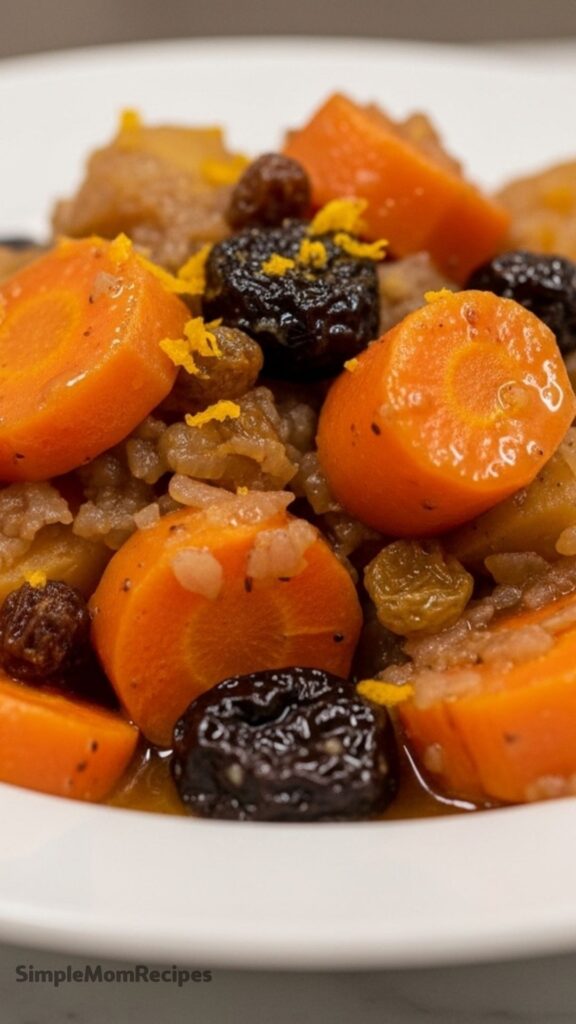
I’ve tried a few versions over time. Some had meat, some were mashed, one had pineapple which I wasn’t totally sold on. I keep coming back to this simple version though. Big chunks, a little glossy, soft but not mushy. Sweet, but not dessert-level sweet. It hits that balance I didn’t realize I cared about until I got it right.
Ingredients I Used for the Recipe
- 2 pounds carrots, peeled and cut into thick slices – these are the base, slightly sweet and hold their shape well
- 2 medium sweet potatoes, peeled and cut into chunks – they add softness and that deeper sweetness
- 1 cup prunes – they melt a bit and give the dish richness and a subtle tang
- 1/2 cup golden raisins – little pops of sweetness throughout
- 2 tablespoons vegetable oil – helps everything roast instead of dry out
- 3 tablespoons brown sugar – just enough to bring everything together
- 1 teaspoon cinnamon – warmth, but not overpowering
- 1/2 teaspoon salt – balances all the sweetness
- 1/4 teaspoon black pepper – I didn’t use it at first, now I always do
- 1/2 cup orange juice – adds brightness and keeps things from getting heavy
How to make Classic Tzimmes Recipe?

Step 1 – Prep everything first
I start by peeling and chopping everything before I even turn the oven on. It sounds obvious, but I’ve rushed this before and ended up with uneven pieces that cooked weirdly. I try to keep the carrots and sweet potatoes roughly the same size so nothing turns to mush while something else is still firm.
Step 2 – Toss it all together
I grab a big mixing bowl and throw in the carrots, sweet potatoes, prunes, and raisins. Then I drizzle the oil and orange juice over everything. Sprinkle in the brown sugar, cinnamon, salt, and pepper. I use my hands most of the time. It’s messy, but I feel like it coats everything better than a spoon ever does.
Step 3 – Spread into a baking dish
Everything goes into a baking dish in a fairly even layer. I don’t pack it too tightly. I learned the hard way that overcrowding makes it steam instead of roast, and that changes the whole vibe of the dish.
Step 4 – Bake low and slow
I bake it at 325°F. It takes about an hour and a half, sometimes a little longer depending on how big I cut things. About halfway through, I give it a gentle stir. Not too much. I still want those edges to caramelize a bit.
Step 5 – Check for that perfect texture
I poke a carrot and a sweet potato with a fork. They should be tender but not falling apart. The liquid should look a little syrupy, coating everything lightly. If it still feels watery, I leave it in uncovered for another 10 minutes or so.
Step 6 – Let it sit before serving
This part took me a while to respect. I used to serve it straight out of the oven, and it was fine. But if I let it sit for 10 to 15 minutes, everything settles, the sauce thickens slightly, and the flavors just come together better.
What I’ve learned after making this more times than I can count
The first time I made tzimmes, I thought more sugar would make it better. It didn’t. It just made everything taste flat and overly sweet. Now I keep it restrained and let the carrots and fruit do their thing.
I also used to skip the orange juice once when I ran out. Big mistake. The dish felt heavier, almost dull. That little bit of acidity matters more than it seems.
And I’ll be honest, I didn’t love prunes at first. I almost swapped them out completely. But once they cook down, they don’t taste like plain prunes anymore. They blend into the sauce and give it depth. Now I wouldn’t leave them out.
Make-ahead habits that save me every time
I rarely make this the same day I serve it anymore. It’s just easier not to. I’ll cook it a day or two ahead, let it cool, and stick it in the fridge. Then I reheat it covered in the oven. Sometimes I add a splash of orange juice if it looks a little dry.
It actually tastes better the next day. I didn’t expect that at first, but now I kind of count on it. The flavors settle and deepen in a way that’s hard to explain but easy to notice.
I’ve even frozen it before when I made too much. That worked fine too. I just thaw it overnight and reheat slowly. Not perfect like fresh, but still really good.
Tips
There are a few small things I do now that make a big difference, even though none of them are complicated.
- Cut vegetables evenly – uneven pieces cook unevenly, and it shows
- Don’t skip the stir halfway through – it keeps things from sticking and helps everything cook evenly
- Use a dish with some space – crowding leads to steaming instead of roasting
- Taste before serving – sometimes I add a tiny pinch of salt at the end to balance things
- Let it rest – this is one of those dishes that improves when you give it a minute
One last thing I’ll say. This recipe is forgiving, but it still responds to attention. When I rush it, it’s fine. When I take my time, it’s something I actually look forward to eating again the next day.
And that’s probably why I keep making it. Not because it’s fancy or impressive, but because it feels steady. Reliable. Like something I can count on to turn out right, even when everything else in the kitchen feels a little chaotic.
Classic Tzimmes Recipe
Description
This classic tzimmes recipe is a cozy, comforting Ashkenazi Jewish side dish featuring tender carrots and sweet potatoes baked with prunes, raisins, and warm spices. Naturally sweet, vegetarian, and dairy-free, it's perfect for Rosh Hashanah or any holiday gathering. Simple to make ahead and reheats beautifully for stress-free entertaining.
ingredients
Instructions
- Preheat the oven to 350°F (175°C) and lightly grease a 9x13-inch baking dish.
- Place the carrots, sweet potatoes, prunes and raisins in a large bowl.
- Drizzle with the vegetable oil, then add the brown sugar, cinnamon, salt and pepper. Toss well to coat all ingredients evenly.
- Pour in the orange juice and toss again to ensure everything is well combined.
- Transfer the mixture to your prepared baking dish and cover tightly with aluminum foil.
- Bake for 1 hour 30 minutes, stirring once or twice during cooking, until the vegetables are tender and the sauce has thickened into a glossy glaze.
- Remove from oven and let rest for 5 minutes before serving warm.
Nutrition Facts
Servings 6
- Amount Per Serving
- Calories 276kcal
- % Daily Value *
- Total Fat 5gg8%
- Saturated Fat 1gg5%
- Trans Fat 0gg
- Cholesterol 0mgmg0%
- Sodium 243mgmg11%
- Potassium 910mgmg26%
- Total Carbohydrate 59gg20%
- Dietary Fiber 8gg32%
- Sugars 33gg
- Protein 3gg6%
- Calcium 78mg mg
- Iron 1mg mg
* Percent Daily Values are based on a 2,000 calorie diet. Your daily value may be higher or lower depending on your calorie needs.
Note
- Make ahead friendly: Prepare up to 3 days in advance; refrigerate and reheat covered at 325°F with a splash of orange juice if needed.
- Freezer option: Cool completely, freeze in airtight container up to 2 months. Thaw overnight and reheat gently.
- Flavor boost: Add a pinch of ground ginger or a strip of orange zest for extra brightness.
- Variation: Substitute dried apricots for half the prunes, or add golden raisins for extra sweetness.
